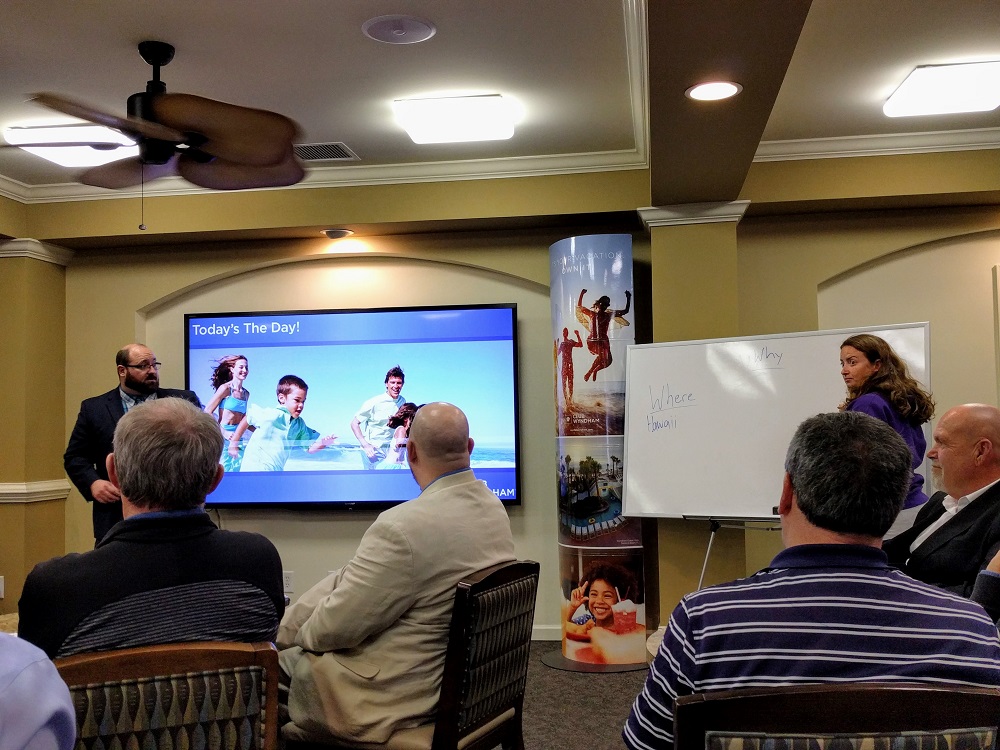
Most people who signed a timeshare contract did not walk in planning to buy one. They showed up for the free breakfast, the gift cards, the theme park tickets. They sat down expecting a short presentation and walked out hours later as timeshare owners. That is not an accident. It is the result of a sales system that has been refined over decades specifically to turn skeptical strangers into buyers before they leave the building.
The first tool is time. Presentations are almost never 90 minutes, regardless of what the invitation says. Three hours is common. Four is not unusual. The length is intentional. As hours pass, hunger sets in, children get restless, and the couple that arrived alert and guarded starts making mental trades. They stop asking hard questions and start looking for the fastest path to the exit. Sales reps are trained to recognize that shift and to press harder exactly when resistance drops.
The physical environment reinforces this. Presentation rooms are typically designed without windows, or with windows that face away from the parking lot. Clocks are rarely visible. The message the room sends, without saying a word, is that outside does not matter right now. You are in a contained space where the only story being told is the one the resort wants you to hear. Snacks and drinks are offered partly out of hospitality and partly because people who are comfortable and slightly distracted are easier to sell.
The sales rep assigned to you is not a random staff member. Resorts often use layered teams. You start with a friendly, conversational 'tour guide' type whose job is to build rapport, learn your vacation habits, and find your emotional triggers. Where do you like to travel? Do you wish you took more vacations? Are your kids getting older and time running out for family trips? These are not small talk. They are intelligence gathering. By the time the actual pitch starts, the rep already knows which emotional lever to pull.
Once the formal presentation begins, scarcity is introduced almost immediately. This unit, this price, this promotion, it is only available today. You will hear that phrase in some form multiple times. Timeshare resorts hold these events constantly, often daily, so the idea that any particular deal is genuinely disappearing at 5 p.m. is almost always false. But scarcity works on the human brain. It creates urgency where none actually exists, and urgency is the enemy of careful thinking.
Pricing is structured to create a false sense of getting a deal. Reps will often present an inflated 'retail' price before revealing the 'special event' price that is supposedly only available because you showed up today. This is a pricing tactic used across many industries, but it hits especially hard in a high-pressure room after three hours of emotional relationship-building. By the time the discounted number appears, some buyers genuinely feel like they are saving money rather than spending tens of thousands of dollars on something they were not planning to buy.
When a couple starts to waver, which is when one partner wants to leave and the other feels guilty about wasting the rep's time, resorts often bring in a closer. This is a different person, typically introduced as a 'manager' or 'director,' who arrives with fresh energy and often a new, slightly better offer. The appearance of a senior figure adds social weight to the room. It signals that your hesitation is being taken seriously and that the resort is going the extra mile for you. In reality, the closer is a specialist whose entire job is to convert the people the first rep could not close.
Owners who eventually sought an exit often describe a moment in that room where they said no clearly, and the conversation simply continued. Saying no once, even twice, did not end the presentation. Reps are coached to treat the first several objections as part of the process rather than as actual decisions. 'I need to think about it' is met with 'what specifically do you need to think about?' 'We can't afford it' is met with a financing offer. Every stated reason to leave is reframed as a problem the resort can solve.
The financing piece deserves its own mention because it is where a lot of financial damage gets done. Many buyers who could not pay the upfront cost were placed into timeshare loans with interest rates between 14 and 20 percent. These are not mortgages backed by real property value. They are unsecured consumer loans dressed up in real estate language. Buyers sitting in that room rarely had time to read the loan terms carefully, and reps were not incentivized to slow down and explain them. People who felt they were buying a vacation asset were actually taking on high-interest debt for something that loses value the moment it is purchased.
Contract signing happens quickly relative to the hours that came before it. A stack of documents is placed in front of a tired buyer, pages are flipped to signature lines, and key terms are summarized verbally in the most favorable possible light. The perpetuity clause, the maintenance fee escalation provisions, the limited-use windows, none of these get the kind of attention they deserve in that moment. And why would they? The buyer is exhausted, the rep is warm and reassuring, and the paperwork feels like a formality after the emotional investment of the previous several hours.
Many owners later report that they felt misled not about any single thing the rep said, but about the overall picture. They were told the timeshare would appreciate. It does not. They were told they could rent it out to offset costs. Doing so is far more complicated than presented, and most owners never recoup meaningful money that way. They were told resale was easy if they ever wanted out. The resale market for timeshares is effectively dead for most ordinary contracts, a reality that Clear Horizon has written about separately.
Understanding that this pressure system exists and knowing how it worked on you does not mean you were foolish or careless. It means you were subjected to a professionally engineered sales environment that has closed tens of thousands of contracts on people just like you. The more useful question now is what you do with that knowledge.
If you are still within the rescission window, typically three to ten days after signing depending on the state or country, you can cancel the contract in writing without penalty. That window closes fast and should be used immediately if it is still open. If that period has passed, the path out is longer but still real. Documentation of what you were promised verbally matters. Notes about the length of the presentation, promises made about resale or rental value, financing terms that were not clearly explained, all of this can be relevant when pursuing a legal exit. A qualified timeshare exit company or attorney who specializes in this area can review your specific contract and tell you what grounds exist for challenging it. The sales tactics described here have formed the basis of legal claims in many cases, because misrepresentation during a sale is not just an ethical problem. In many jurisdictions, it is a legal one.