
Introduction
The number on your timeshare purchase agreement is just the starting line. Annual maintenance bills, special assessments, exchange charges, and exit costs are where the real financial burden shows up.
Retirees on fixed incomes, families who inherited a timeshare they never wanted, and owners who can't travel like they used to feel this pressure most. A fee that felt minor at closing can grow into thousands of dollars owed annually, with no travel to show for it.
This article breaks down the fee categories owners commonly encounter and shows you where to find them in your paperwork. It also outlines practical steps if the obligation has become more than you can manage.
Key Takeaways
- Total ownership cost includes maintenance fees, special assessments, exchange charges, financing costs, and exit-related expenses.
- Fees stay hidden when they're vague, bundled, or subject to change without a stated cap.
- Owners typically owe contracted fees regardless of usage; consequences for nonpayment depend on the contract and state law.
- Get every fee in writing before signing or paying an exit company, and verify credentials first.
What Hidden Timeshare Fees Are and Why They Matter
A hidden timeshare fee isn't necessarily illegal or undisclosed on paper. It's a cost that wasn't emphasized during the sales presentation, or one buried in language most people skim past. That includes charges that only appear later, amounts that shift year to year, and fees that only kick in when you actually use, transfer, or try to exit the contract.
Not all fees behave the same way:
- Recurring fees: billed every year regardless of whether you visit, such as maintenance and management charges.
- One-time fees: assessed once for a specific event, like a special assessment after storm damage.
- Conditional charges: apply only under certain circumstances, such as fees triggered by a transfer or ownership change.
- Usage-based fees: kick in only when you book, exchange, or bring a guest.
The FTC advises timeshare buyers to add up the initial purchase price, ongoing fees, taxes, and travel expenses before deciding whether an offer makes financial sense. That's the total cost of ownership, and it's rarely what gets discussed at the sales table.
A purchase that looked affordable in year one can look very different by year fifteen. Clear Horizon Financial's maintenance fee calculator models fee growth under conservative, typical, aggressive, and worst-case annual increase rates. Most clients face $80,000 to $200,000 or more in projected lifetime fees.

Common Hidden Timeshare Fees
Fee names, due dates, and increase rights vary by resort, developer, and contract. Always confirm current figures against your own statements rather than assuming a "typical" number applies to you.
Annual maintenance and management fees
These recurring charges cover upkeep, staffing, common-area operations, and reserve contributions. They're due whether or not you ever set foot on the property.
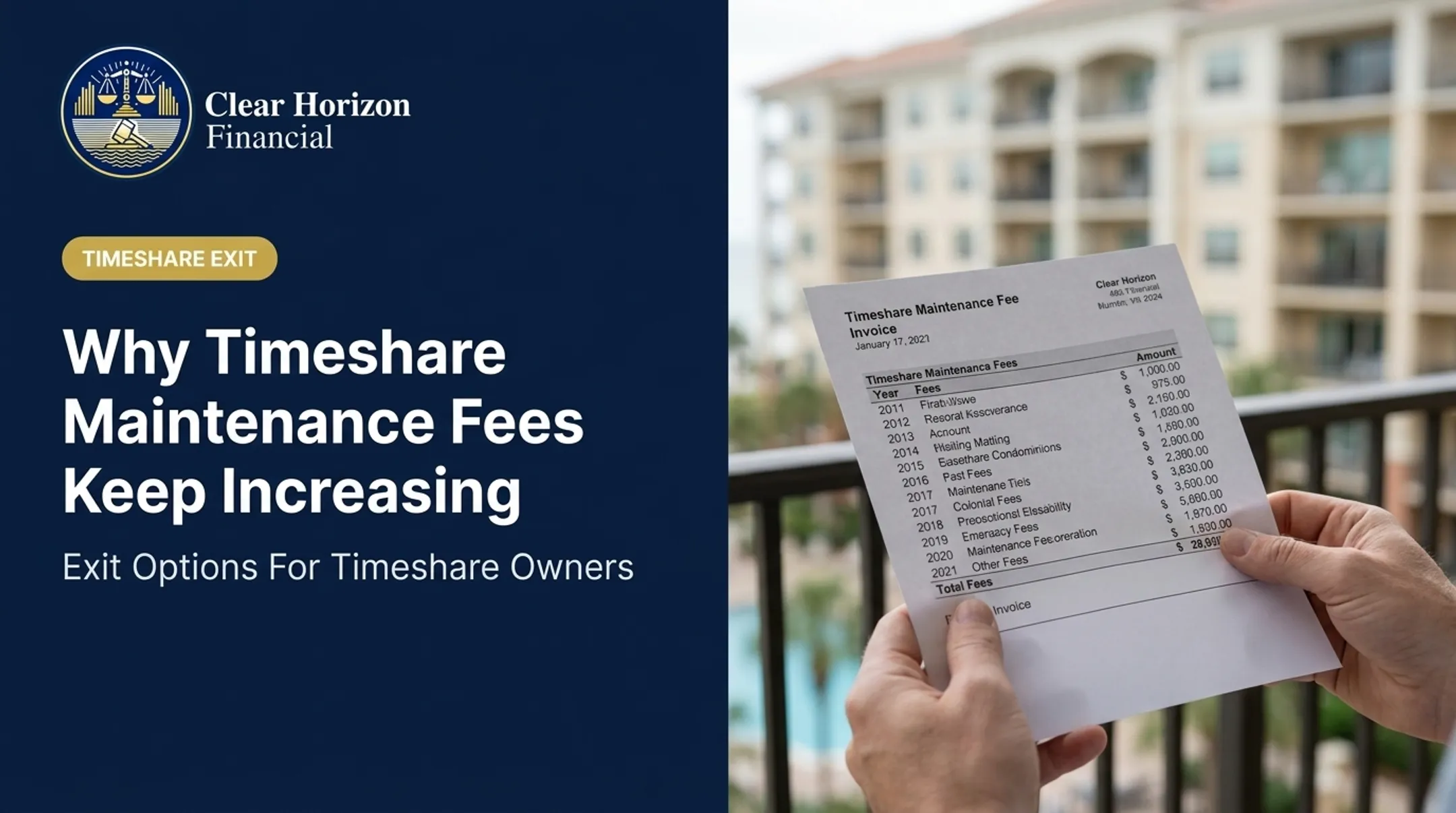
According to ARDA's 2026 State of the Industry report, the national mean maintenance fee reached $1,550 per weekly interval in 2025, up from $1,480 in 2024, a 4.7% increase in a single year.
Contract language often permits increases tied to operating expenses, reserve funding, or management decisions, frequently without a stated ceiling. Clear Horizon Financial has reviewed contracts where fees rose 62% since 2020, turning a $1,200 annual bill into one exceeding $1,900.
Special assessments, reserve shortfalls, and property-related charges
Special assessments are separate, occasional charges layered on top of your regular maintenance bill. They typically cover major repairs, storm damage, renovations, or code-compliance projects that reserves didn't fully fund.
These assessments can add hundreds or thousands of dollars with little advance warning, arriving as a surprise bill rather than a budgeted expense.
Property taxes, insurance, and utilities may be bundled into your maintenance statement or billed as a separate line item, depending on the resort.
Exchange, membership, reservation, and booking fees
Paying your maintenance fee doesn't mean you're done spending. Exchange programs typically charge:
- An annual membership fee to participate
- A separate transaction fee each time you book an exchange
- Guest-certificate charges if someone else uses your reservation
- Peak-season surcharges or upgrade fees for premium weeks
These charges stack on top of maintenance fees and can turn a "free" week into an expensive one.
Financing, interest, and purchase-related administrative costs
If you financed your purchase, interest adds up over the loan term, often at rates well above a typical mortgage. Beyond interest, expect separate line items such as:
- Document preparation fees
- Title or recording charges
- Transfer taxes
- Closing costs
These frequently appear apart from the advertised purchase price, which is why the sticker price rarely matches what buyers actually pay.
Travel and use-related expenses
None of the following are technically "ownership fees," but they add real cost every time you use your timeshare:
- Airfare or fuel to reach the resort
- Lodging before or after your stay
- Resort fees, parking, and housekeeping charges
- Meals, internet, and activity add-ons
For owners who once traveled easily but now find it harder physically or financially, these costs can make an already-expensive obligation feel out of reach.
Resale, transfer, and exit-related charges
Selling or transferring a timeshare rarely works the way owners expect. Clear Horizon Financial has found that fewer than 3% of timeshares ever successfully resell, and most contracts require resort approval before a transfer can happen at all.

That's where third-party "exit" companies enter the picture, and where owners need to be careful. Legitimate listing, marketing, closing, deed, or legal fees should be disclosed in writing before you pay anything. Be wary of:
- Guaranteed-outcome promises before anyone reviews your contract
- Large upfront payments with no escrow protection
- Pressure to decide within 24 to 48 hours
Get every fee in writing and verify the company before you pay.
How to Find and Plan for Hidden Fees
Before you can plan around these costs, you need to see the full picture. That starts with a total cost of ownership review, not just a glance at last year's maintenance bill.
Gather these documents first:
- Purchase agreement and deed
- Financing paperwork
- Current and prior maintenance statements
- Resort rules and exchange-program terms
- Owner notices and any sales or exit-company communications
Once you have everything together, search for language that flags fee risk:
- "Subject to change" or other uncapped increase language
- "Special assessment" and "reserve" charges
- "Transfer approval" or "administrative fee"
- "Default," "collection," or "foreclosure"
- "Perpetual" obligations that could pass to heirs
Ask your resort for a written fee schedule that separates maintenance, taxes, assessments, exchange costs, late charges, and transfer fees. Verbal assurances from a salesperson or call center rep don't hold up if the contract says otherwise. Only the signed document is enforceable.
Run through this checklist before you sign anything new, or before you assume you fully understand what you already own:
- Can fees rise without a stated cap?
- Which charges apply even when the timeshare goes unused?
- Who's responsible for assessments after a transfer?
- What are the cancellation or rescission deadlines?
- What actually happens if a payment is missed?
Use those answers to build a simple annual reserve. Budget for current maintenance fees plus a cushion for assessments, exchange costs, and possible late or transfer charges.
What to Do If Timeshare Fees Have Become Unaffordable
Stopping payment without a plan is one of the riskiest moves an owner can make. Depending on your contract and state, consequences can include late charges, loss of booking access, collections, credit reporting, foreclosure, or litigation.
Florida law, for example, allows a late charge of up to $25 per delinquent assessment, plus collection costs, and permits an assessment lien or foreclosure under Florida Statutes 721.15. These outcomes are possible, not automatic—but real enough to take seriously.
Start with these steps, in order:
- Check your rescission window first. New purchases often allow only 3 to 15 days to cancel, depending on the state—use the exact delivery method your contract requires, not a phone call.
- Contact the resort in writing. Ask about payment plans, hardship programs, deed-back or surrender options, and your exact balance. Keep copies and proof of delivery.
- Understand deed-back eligibility. Most programs require owners to be current on fees and free of any loan balance before they'll consider an application.
- Get a professional review before paying anyone. A qualified review can flag misrepresentation, undisclosed obligations, or contract defects that open a legitimate exit path.

Clear Horizon Financial builds on that review. Our AI-powered contract analyzer scores each deed and agreement for perpetuity clauses, uncapped fee escalation, and one-sided exit rights.
A dedicated case manager then handles formal cancellation filings, regulatory complaints, and resort communications. You can track progress in real time through a private client portal. Not every owner qualifies for an exit, but a free 20-minute case evaluation carries no obligation.
Before hiring any exit company, verify:
- Independent business credentials (BBB status, complaint history, years operating)
- A written scope of work and complete fee schedule
- How "success" is documented in writing, not only promised verbally
- Whether guarantees include enforceable terms, not vague assurances
Paying a third party never automatically releases you from the resort's obligation. Only a documented resort release does that.
Conclusion
The most damaging hidden costs in timeshare ownership rarely arrive as one dramatic surprise bill. More often, they build quietly: a maintenance fee that climbs a few percent every year, an assessment nobody budgeted for, exchange charges that stack up trip after trip, and exit costs that catch owners off guard when they finally decide to leave.
Before you sign anything new, default on a payment, or pay an exit company, lock down the details first:
- Get every fee and every consequence in writing
- Review your governing documents closely
- Do not sign, default, or pay an exit firm until you understand the full cost
When the obligation already feels bigger than you can manage, get a contract review before you act. Clear Horizon Financial offers free deed and contract evaluations so you can see your options in writing first.
Frequently Asked Questions
How can I get rid of my timeshare without paying fees?
A completely free exit isn't guaranteed for every owner. Check your rescission rights, ask about resort deed-back or surrender programs, and be cautious of any exit company demanding large upfront payments with guaranteed results.
What happens if you refuse to pay timeshare maintenance fees?
Consequences can include late charges, loss of booking access, collections, credit reporting, foreclosure, or legal action, depending on your contract and state law. Get guidance before you stop paying.
Are timeshare companies required to give refunds?
Refunds depend on your contract, applicable rescission laws, evidence of misrepresentation, or a settlement or court outcome. Not every cancellation results in a refund.
Is there a class action lawsuit against timeshare companies?
Lawsuits and investigations change frequently, and eligibility depends on the resort, allegations, and jurisdiction involved. Verify any claim through official court records or regulatory sources before assuming it applies to you.
What fees should I look for in a timeshare contract?
Review maintenance fees, special assessments, taxes, financing charges, and exchange or reservation fees. Also check guest, transfer, resale, administrative, late, and exit-related charges, plus any clause that lets fees rise over time.
Can timeshare maintenance fees increase every year?
Many contracts allow annual increases, but the frequency, method, and any caps vary by agreement. Compare your current statement against prior years and re-read the fee-adjustment clause in your contract.