
What's at stake is real. Maintenance fees keep billing whether you use your week or not — the industry average hit $1,550 per interval in 2025, before taxes or special assessments, according to ARDA's 2026 State of the Vacation Timeshare Industry report. Add a delinquent balance, a lingering loan, or a surprise assessment, and the math gets worse fast. There's also credit exposure, months of waiting, and the need for actual proof — not a phone call — that your obligation has ended.
This guide walks through the decision framework in order: check your direct, no-cost options first, weigh the cost and risk of each remaining path, then vet any outside provider before you sign anything or pay a dollar.
Key Takeaways
- Check rescission first: windows often close within days of signing
- Deed-back or hardship programs can be simpler, but the resort controls eligibility
- Resale or transfer ends your obligation only once a new party formally assumes it, not before
- Bring in professional help for complex contracts, misrepresentation claims, or delinquency you can't resolve alone
- A closed file or a skipped payment is never proof your timeshare obligation is over
What Are Timeshare Exit Options?
A timeshare exit option is any legitimate route for ending, transferring, surrendering, disputing, or otherwise resolving your ownership or membership obligation. Exit can cover more than one obligation at once: your ownership interest, an outstanding loan, unpaid maintenance fees, a special assessment, or an account already in collections.
Your contract type matters too: a deeded interest, a right-to-use membership, a fixed or floating week, or a points-based program each carry different rules. Before choosing a path, gather:
- Purchase contract
- Deed or membership documents
- Loan statements
- Fee history
- Resort correspondence
Rescission or Cooling-Off Period
Rescission is a short cancellation window that opens right after you sign. How short depends on your state and contract — Florida gives buyers 10 calendar days after signing or receiving the last required document, while other states allow as few as 5 to 7 days, per the Florida Senate's timeshare statute. Miss it, and this option disappears.
Follow the cancellation instructions in your contract exactly. Use the delivery method it specifies (often certified mail with return receipt), send it to the correct recipient, and keep copies of everything. If the deadline or procedure is unclear, get independent legal guidance right away.
Direct Resort Surrender, Deed-Back, or Hardship Program
Some developers offer a deed-back, surrender, or hardship program that lets you walk away without a resale or a third party. Eligibility usually depends on:
- Being current on maintenance fees
- Having no loan balance
- Meeting a minimum ownership period
In one documented Vacation Village Resorts deed-back, the exit closed in 144 days, the deed was recorded at the county clerk's office, and no future fees remained. Before you count on this route, get the resort's written eligibility requirements and final confirmation — specifically, whether future maintenance fees, assessments, and dues actually stop.
Resale, Transfer, or Donation
Selling, transferring, or donating your interest is not the same as canceling it. You remain responsible for fees and assessments until a new owner formally assumes the obligation, verified by a recorded deed or accepted membership transfer, not a handshake.
Watch for unsolicited buyers, upfront resale fees, and donation offers that never explain who takes over the financial obligation. Internal research suggests fewer than 3% of timeshares ever successfully resell, and most contracts require the resort's permission before any transfer proceeds.

DIY Negotiation or Formal Correspondence
You can contact your resort, developer, homeowners' association, or lender directly about hardship assistance, transfer, payoff, or account resolution. No intermediary required.
Keep a dated log of every call and email, and insist that promised terms come in writing. Phone assurances from a customer-service rep don't hold up if the account isn't updated later.
Professional Exit Assistance or Legal Advice
A professional exit provider can help with contract and deed review, formal filings, resort communication, and case escalation. A licensed attorney becomes appropriate when there's alleged fraud, active litigation, foreclosure, or a complex loan dispute requiring legal advice a nonlawyer can't give.
Before signing anything, confirm:
- Whether the company is a law firm
- Whether an attorney personally represents you
- Exactly what the engagement includes
- What result the written agreement promises The Federal Trade Commission recommends contacting your resort directly before hiring anyone: it's a free step that can rule out a paid one entirely.
What to Consider When Choosing the Best Timeshare Exit Option
The most attractive option isn't always the safest or cheapest one. Compare each route against your actual contract, financial exposure, urgency, and ability to manage a multi-month process.
A simple starting framework works for almost everyone:
| If your situation is... | Investigate first |
|---|---|
| Purchased within the past 1–2 weeks | Rescission deadline in your contract and state |
| Current on fees, loan paid off, ready to walk away | Resort deed-back or surrender program |
| No longer using it, want someone else to take over | Resale or transfer feasibility |
| Behind on payments or facing collections | Direct resort hardship conversation, then legal or financial advice |
| Believe you were misled at the sales presentation | Evidence preservation and professional or legal evaluation |
No route on this table is guaranteed. It only tells you where to start looking.
Your Contract and Ownership Structure
Deeded ownership, right-to-use memberships, fixed weeks, floating weeks, points systems, and multiple linked contracts all affect which exit routes are available. A deeded interest transfers via an actual deed. A right-to-use membership has no deed and follows entirely different termination rules.
Pull your original documents and check:
- Governing law and cancellation clauses
- Transfer restrictions and resort rules
- Perpetuity language
- Any right-of-first-refusal provision
If you own points, remember you're accessing an inventory pool, not a fixed unit. That changes how a transfer or buyout gets valued.
Your Loan, Fees, and Account Status
A paid-off, current account has different options than one with an outstanding loan, unpaid fees, a special assessment, or a delinquent balance already in collections. Surrendering or transferring ownership does not automatically erase a loan or past-due balance. Ask exactly how each obligation gets resolved, and get it in writing.
Never stop paying just because someone recommends it. Nonpayment can trigger foreclosure proceedings, a lien, collections referrals, credit damage, and potentially a 1099-C for canceled debt. Get qualified financial or legal advice before making any payment decision.
The Reason You Want to Exit
Match your trigger to the right question:
- Rising fees call for a straight cost comparison against continued ownership
- Nonuse makes direct surrender or transfer worth exploring first
- Inheritance means reviewing estate documents and title before anything else
- Alleged misrepresentation means preserving evidence (brochures, presentation notes, recorded promises) before it disappears
Define your desired result before you compare providers: ending future ownership, resolving a loan, clearing delinquency, protecting an estate, or challenging the original sale.
Total Cost and Likely Timeline
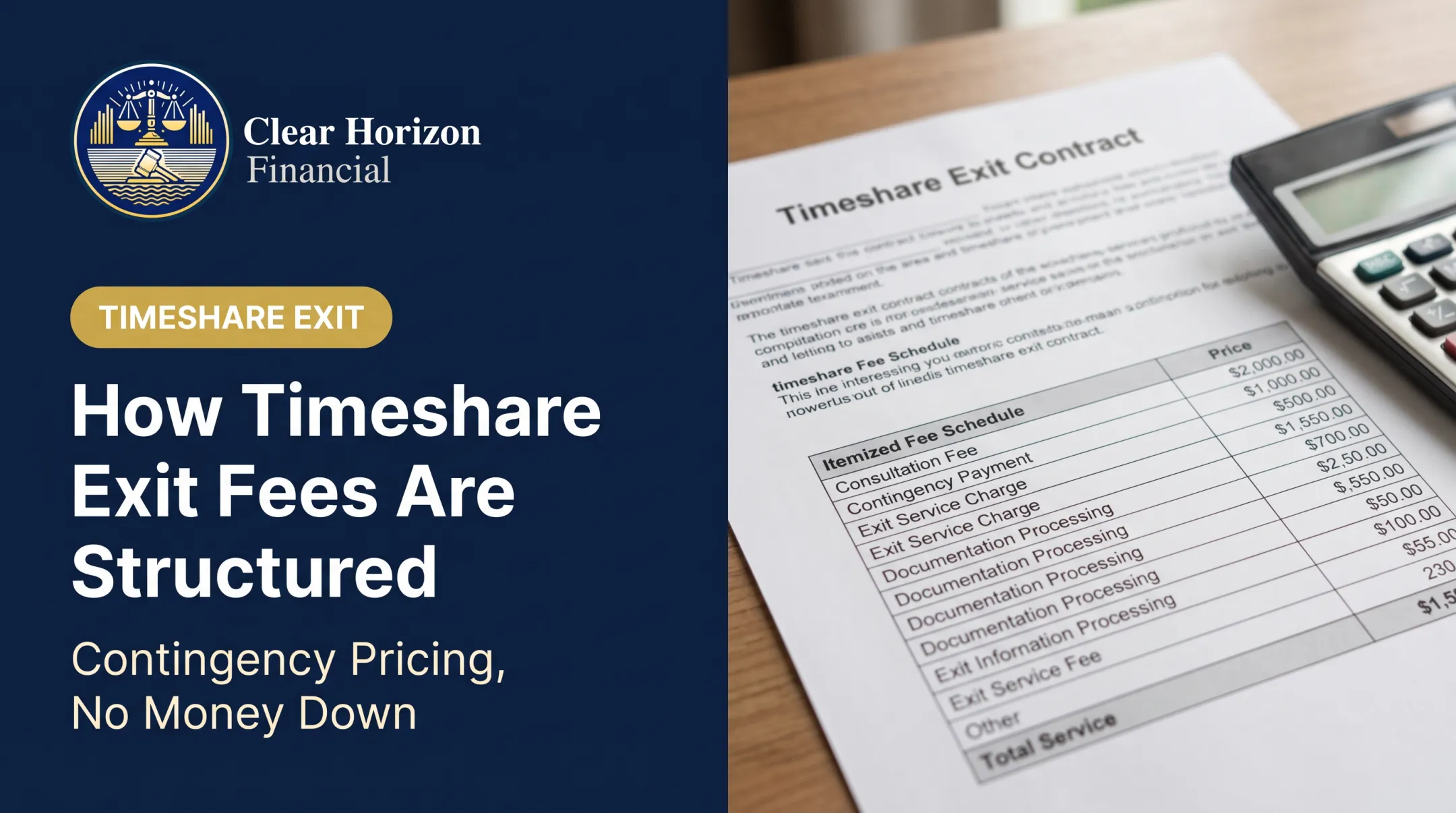
Compare upfront fees, resort charges, transfer or recording costs, legal fees, continuing maintenance fees, loan payments, assessments, and any tax or title expenses. Then run a break-even comparison between the exit cost and the projected cost of continued ownership, using your actual contract numbers.
Timelines vary by resort, contract, and account status. Internal case data shows a 270-day average to a documented, confirmed exit, with straightforward cases closing in as little as 111 days and complex or decades-old contracts taking longer. Require any provider to state milestones, your responsibilities, and what happens if the initial strategy doesn't work.

Provider Credibility and Service Model
Verify business identity, BBB profile, complaint history, and recent independent reviews before paying anyone. Search the company name alongside "complaint" or "lawsuit," and check whether it has actually worked with your specific resort and state.
Understand the difference between transfer services, negotiation support, contract-analysis firms, and attorney-led representation. The provider should describe the actual strategy before you pay, not after.
Red flags to walk away from:
- Pressure to sign within 24–48 hours
- A guaranteed cancellation regardless of your circumstances
- Vague legal claims without a named attorney
- An unsolicited "waiting buyer"
- A large upfront fee with no explanation
- Advice to simply stop paying
- Refusal to put the agreement in writing
Proof That the Exit Is Complete
A provider's case closure or a mailed letter is not proof your ownership ended. Depending on your contract type, real proof looks like a recorded deed, an accepted surrender, a terminated membership, a released loan, or a closed fee account.
Check every associated contract, deed, points account, loan, and maintenance-fee account separately. Closing one doesn't automatically close the others. Store your final documents, and confirm directly with the resort or developer's records whenever possible.
How Clear Horizon Financial Can Help
If you've checked rescission, contacted your resort, and ruled out a straightforward transfer, Clear Horizon Financial offers a structured next step for owners who need documented, case-managed assistance.
The process starts with a free deed and contract review. David Reyes, our Deed Analysis Expert, examines your actual documents for case-specific leverage points: perpetuity clauses, uncapped fee escalation, one-sided exit rights, or misrepresentation indicators. Strategy is built only after that review.
From there, a dedicated senior case manager handles filings, resort communication, and escalation. A private portal keeps documents, messages, and real-time progress tracking in one place.

What we bring to a case:
- 25+ years of timeshare exit experience and more than 1,500 families helped
- Direct experience with Wyndham, Westgate, Marriott, and Diamond contracts
- BBB accreditation with an A+ rating, held for 11 years
- A written money-back guarantee, with exact terms spelled out before you sign
Before hiring Clear Horizon Financial, or any provider, ask:
- What the proposed strategy actually addresses
- Whether an existing loan or past-due balance is included
- What documents will prove the exit is complete
- What stays your responsibility during the process
- How the guarantee works if the exit doesn't succeed
A provider that can't answer those questions plainly isn't ready to take your case.
Conclusion
Choosing between timeshare exit options starts with your contract and your specific problem, not the flashiest ad or the lowest quoted fee. The sequence holds up regardless of your situation:
- Check rescission first
- Contact the resort directly
- Evaluate whether transfer or resale is realistic
- Identify any legal or financial complications
- Compare providers carefully if you still need help Whatever path you take, preserve every document, resist rushed decisions, and never follow default advice without understanding the consequences. If your circumstances involve fraud allegations, foreclosure, or a complicated loan, get independent legal or financial guidance alongside whatever exit strategy you pursue. Get written proof that every obligation, on every linked account, has actually ended before you consider the process finished.
Frequently Asked Questions
What is the cheapest way to get out of a timeshare?
Rescission is usually free if you're still within your state's deadline. After that, a direct resort surrender or deed-back can be low-cost for eligible owners, though transfer fees, loan balances, and ongoing charges still vary by resort.
Can I get out of a timeshare without hiring an exit company?
Yes. Many owners use rescission, contact the resort directly, request a deed-back, or pursue a legitimate transfer on their own. Complex disputes involving misrepresentation or delinquency often benefit from professional or legal advice.
How do I know which timeshare exit option is right for me?
Compare your contract type, rescission eligibility, loan and fee status, reason for exiting, urgency, and budget. Then confirm you can get written proof that every obligation actually ended before committing to a path.
Can a timeshare exit company help if I still owe money?
An outstanding loan is a separate financial obligation from your ownership interest. Ask any provider exactly how their strategy addresses the loan, maintenance fees, and any delinquent balance before you sign.
Is selling a timeshare better than using a deed-back program?
It depends on your account status, resort eligibility, and how much control you want. Deed-backs are often faster and cheaper when you qualify, while resale gives you more control but rarely returns a profit.
How can I avoid timeshare exit scams?
Check independent reviews and complaint records, and require a written strategy and agreement before you pay. Verify any legal representation directly, and reject pressure tactics, guaranteed results, or advice to simply stop paying.