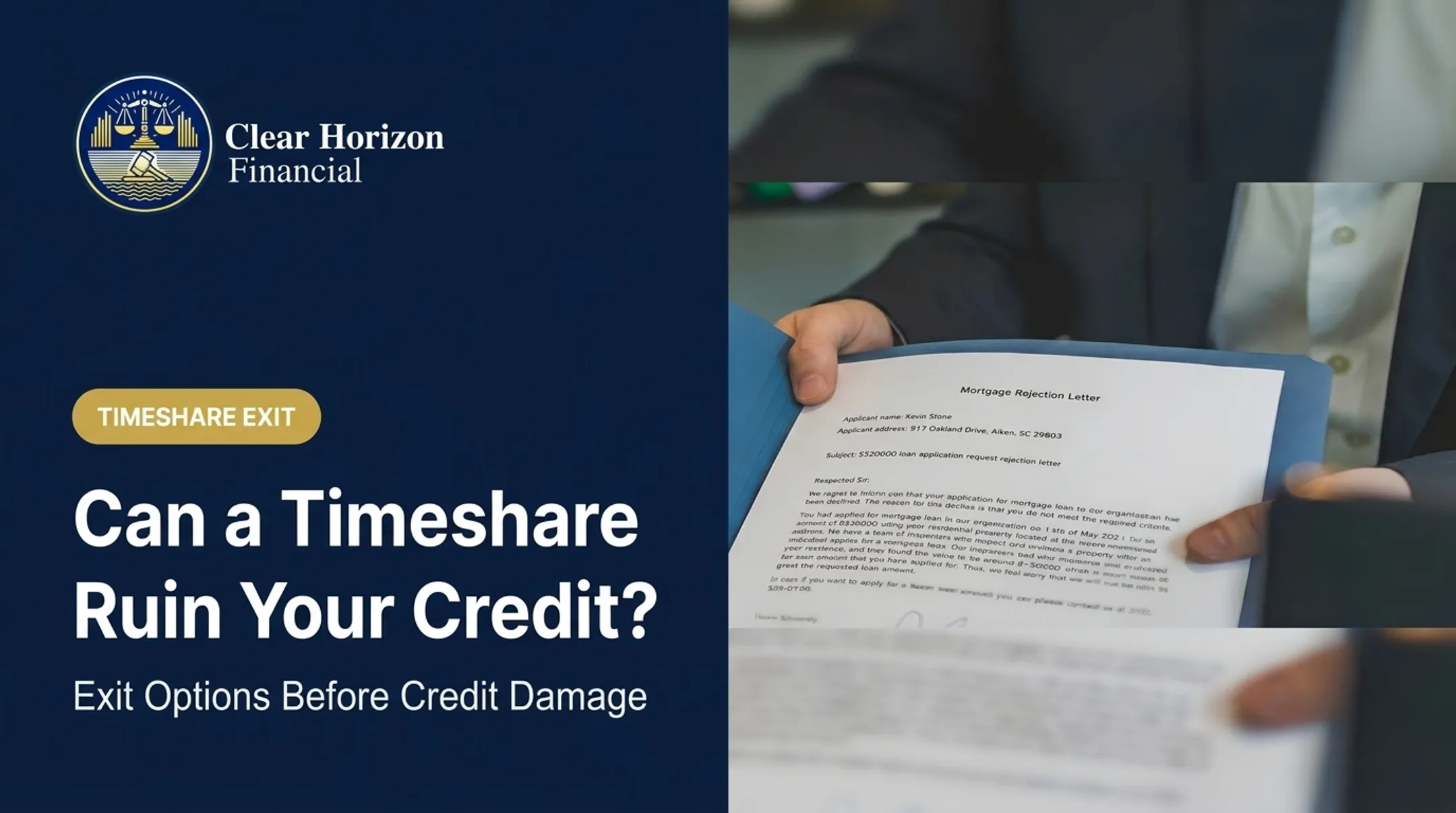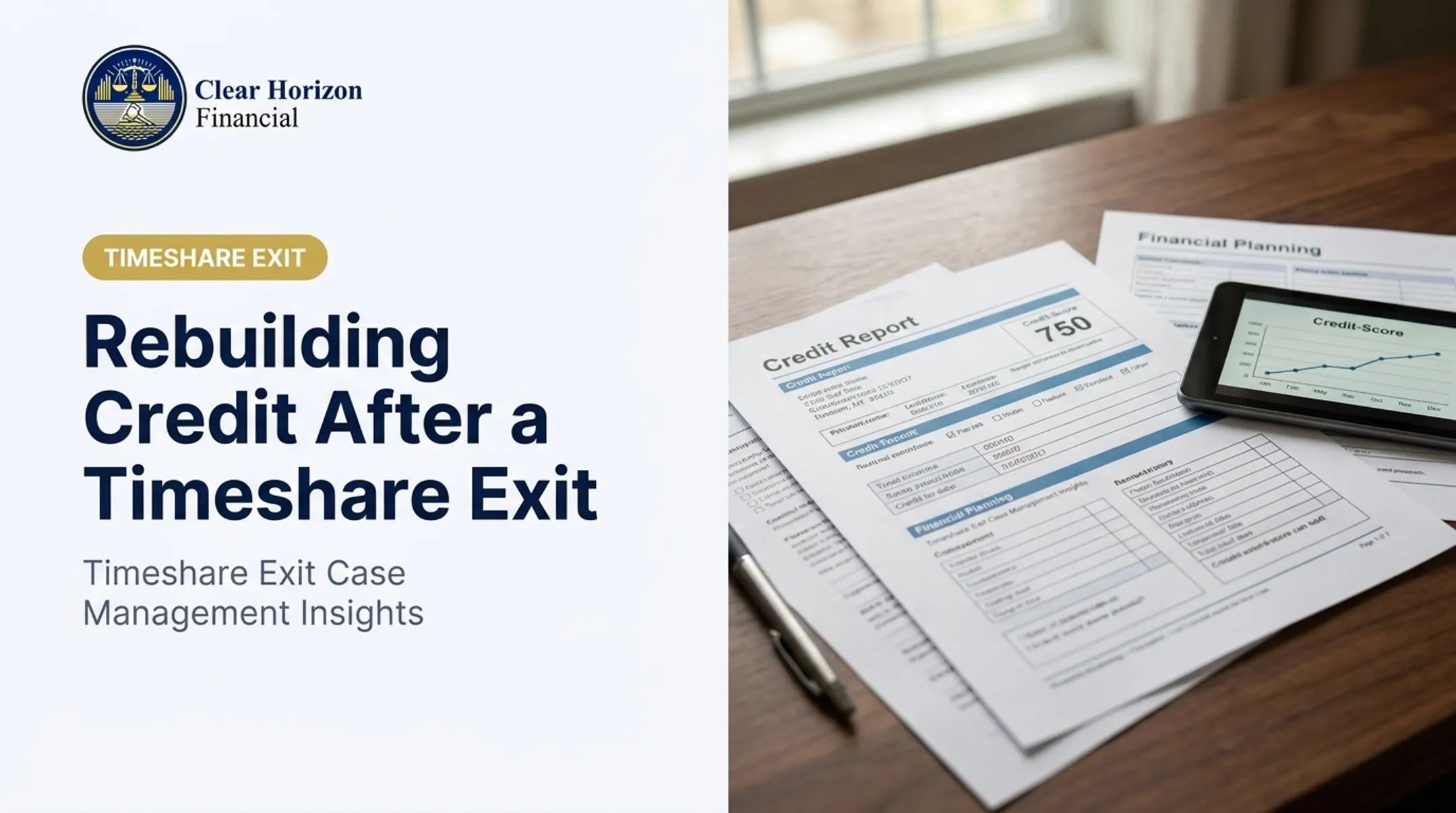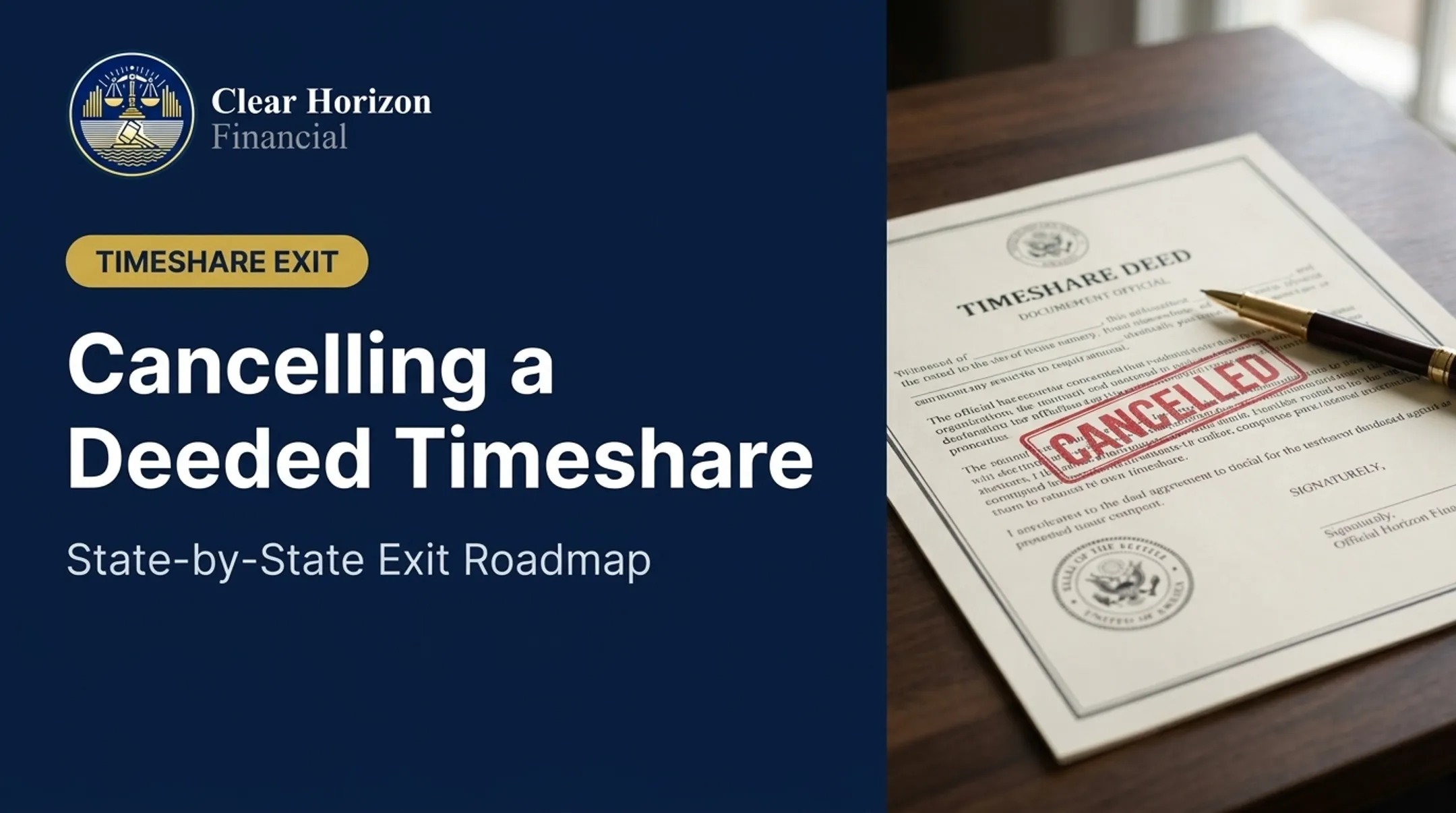

Here's the distinction that matters most: a formal, documented cancellation or release is a different animal than simply stopping payments and walking away. One closes your obligations on paper. The other invites late fees, collection calls, and potential foreclosure activity.
This article walks through how timeshare debt actually appears on a credit report, what changes (and doesn't) with different exit paths, and the specific steps you can take before, during, and after an exit to protect your score.
Key Takeaways
- Rescinding inside your state's cancellation window usually avoids credit damage; exiting an older contract does not.
- Missed payments, collections, and wrong balances hurt credit; a documented release ends future obligations.
- Contacting an exit company does not pause payments unless a written agreement says so.
- Keep every contract, payment record, release letter, and dispute response in one file.
How Timeshare Cancellation Can Affect Your Credit
Why a Timeshare Shows Up on Your Credit Report at All
Not every timeshare purchase creates a credit report entry. It depends entirely on how you financed it:
- Developer financing — often reported as an installment loan
- Mortgage-secured note — sometimes attached to the timeshare interest itself
- Branded credit card — used for the purchase or ongoing fees
- Cash purchase — may never appear if the resort doesn't furnish data to the bureaus
The federal appeals case Holden v. Holiday Inn Club Vacations shows how a buyer's promissory note can be secured by a mortgage on the timeshare. Developer financing frequently carries interest rates between 14% and 18%, according to internal Clear Horizon Financial data on timeshare loan terms. A high-interest balance left unpaid escalates fast.
Paid-as-Agreed vs. Delinquent Accounts
An account you're paying on time simply sits on your report as part of your debt mix. It's the missed payments that cause damage. Once you're 30 days late, that status can be reported and may stay on your file for up to seven years, per credit-reporting guidance from Experian.
Under the Fair Credit Reporting Act, most collections and charge-offs also fall off after seven years. For accounts sent to collection, the clock starts 180 days after the delinquency that triggered it, not the collection date itself (15 U.S.C. § 1681c). Foreclosure timelines vary depending on which agency you ask, so don't assume a single universal date applies to your situation.

Fees, Loans, and Cards Don't Always Move Together
Paying off your purchase loan doesn't automatically end your maintenance-fee obligation. Many state laws — Arizona and North Carolina among them — treat overdue assessments as a separate debt of the owner, collectible on their own timeline with their own fees attached. Cancelling one part of your timeshare arrangement rarely resolves every balance tied to it.
Three quick scenarios illustrate the difference:
| Situation | Credit risk level |
|---|---|
| Signed last week, still inside rescission window | Low — cancel per contract terms |
| Loan paid off, maintenance fees still owed | Moderate — fees can still go to collections |
| Financed owner already getting delinquency notices | High — foreclosure or collection risk is active |
How Different Exit Options May Affect Credit
Rescission (Early Cancellation)
Every state sets its own rescission window, method, and delivery requirements. Florida gives buyers 10 calendar days from the later of signing or receiving required documents. Nevada gives just 5 calendar days, and that right can't be waived by contract.
Completed on time and by the required method, rescission voids the contract before ongoing fees stack up, so it typically leaves no negative credit mark. Miss the method or the deadline, and the rescission simply doesn't count. Verify your state's specific rule before sending anything.
Deed-Back or Surrender Programs
Some resorts accept a deed-back, taking the property back and releasing you from future fees. Availability and eligibility vary by resort, and it's rarely automatic. Credit impact depends on how the account is closed, so get the terms in writing:
- Which fees, if any, remain due
- Whether any balance survives the transfer
- How the account will be reported once complete
Transfer or Resale
An interested buyer or a listing isn't a release. Fewer than 3% of timeshares ever successfully resell, and you can't simply give one away without the resort's approval. Until a transfer is properly executed and confirmed in writing by the resort or HOA, you remain the owner of record—still on the hook for fees, and for any late or collection reporting tied to them.
Negotiated Settlement or Release
A settlement can resolve a balance for less than what's owed, but Experian notes this is still reported as a negative status, distinct from paying in full. Ask directly whether any forgiven debt could trigger a 1099-C tax form before you sign anything.
Stopping Payments Without a Completed Exit
This is where the real risk lives. No exit company, regardless of what it promises, can override a lender's right to report a missed payment. Stopping payments before an agreement is fully executed can trigger late reporting, collections, or foreclosure — the opposite of what you were trying to avoid.
Steps to Protect Your Credit During a Timeshare Exit
Documentation, continued payments, and written proof are what keep a timeshare exit from spilling onto your credit. Work these steps in order.
Gather your paperwork before you act. Collect:
- Original contract and any amendments
- Financing agreement
- Deed or membership records
- Maintenance-fee statements and assessment notices
- Every written sales representation
Pull your credit reports. Use the federally authorized AnnualCreditReport.com to check Equifax, Experian, and TransUnion. Identify every timeshare-related account, its balance, and its payment status.
Ask pointed questions in writing before signing with anyone:
- What obligation is actually being cancelled?
- Do payments remain due while the case is under review?
- How will the account be reported once resolved?
- What document proves the exit is complete?
Keep paying until you have a written agreement that says otherwise. A phone call to an exit provider isn't proof you can stop. Clear Horizon Financial, for example, builds this expectation into its process. The firm sends a formal cancellation demand by certified mail with return receipt. The resort then has a defined response window (typically 15 business days) before any fee release is confirmed in writing.
Log everything as you go. Store dated communications, delivery confirmations, payment receipts, and release letters in both digital and physical form.
Confirm the release after the exit closes. Verify the resort's written release, then check each credit report so the account reflects it. Don't ignore a collection notice that arrives afterward. Respond immediately.

Checking and Disputing Timeshare Credit Reporting
Once you've pulled your reports, look specifically for:
- Duplicate reporting — the same debt listed by both a creditor and a collector
- Incorrect balance — a total that doesn't match your payment records
- Late-payment marks — notations that don't match what you actually paid
- Open account after release — still marked open after you received a release
- Incorrect foreclosure or collection status — a status that doesn't reflect the account
How to dispute errors (CFPB process)
- Dispute the error with the credit bureau reporting it and the furnisher (the creditor or collector) directly.
- Attach your contracts, payment records, release documents, and delivery confirmations.
- Wait for the bureau’s 30-day investigation.
- If confirmed inaccurate, the furnisher must correct or remove it and notify the bureaus.
Dispute only information that is inaccurate or unverifiable. Accurate entries you dislike are not grounds for removal. If your case involves a complex or unresolved reporting error, a consumer-law attorney can help you push further.

Choosing Help and Avoiding Timeshare Exit Scams
Before hiring anyone, run a basic background check. Search the company's name alongside terms like "complaint" or "scam," confirm their contact information is real, and request a written scope of work with a clear fee schedule.
Warning signs the FTC specifically flags:
- Guarantees of cancellation regardless of your contract terms
- Claims that credit damage is "impossible"
- Large upfront fees with no clear deliverable
- Instructions to stop paying your mortgage or fees without a written legal basis
- Refusal to explain who actually communicates with your resort or lender
These aren't hypothetical. In 2026, a federal court ordered a timeshare-exit operator to pay $140 million after allegedly defrauding consumers with false cancellation promises.
When you evaluate legitimate help, prioritize documentation and clear responsibilities over guarantees.
Clear Horizon Financial, based in Altamonte Springs, Florida, is one option built around that approach. Its process includes:
- AI-assisted deed and contract analysis
- A dedicated case manager per file
- Formal certified-mail filings and resort-response handling
- A private client portal for tracking progress
Its services and any written money-back guarantee are governed by the client agreement and don't promise a specific credit outcome. No legitimate provider can make that guarantee.
Whatever provider you consider, compare their answers on payment obligations, documentation, communication responsibilities, fees, and timelines against what a direct resort program or a consumer-law attorney offers before you enroll.
Frequently Asked Questions
Will cancelling a timeshare hurt my credit?
Not automatically. Cancellation itself isn't a negative credit event — but unpaid financing, fees, collections, or inaccurate reporting tied to the timeshare can be.
What happens to my credit if I stop paying timeshare fees?
Unpaid fees can lead to late-payment reporting, collections, or foreclosure depending on your contract and state law. Get situation-specific guidance before you stop paying anything.
Can I cancel a timeshare without affecting my credit?
A properly completed rescission or documented exit may avoid new negative reporting, but the outcome depends on your contract, account status, and the creditor's reporting practices.
Does a paid-off timeshare affect my credit?
A paid-off loan may no longer function as an active account, but maintenance fees, assessments, and association charges can still create separate obligations and reporting risk.
How do I dispute inaccurate timeshare information on my credit report?
Identify the specific error, gather your supporting documents, and dispute it with both the credit bureau and the furnisher. Keep copies of every submission and response.
How can I avoid timeshare exit scams?
Research the provider, get every promise and fee in writing, and avoid anyone pressuring you to sign immediately or stop paying without a written legal basis.